
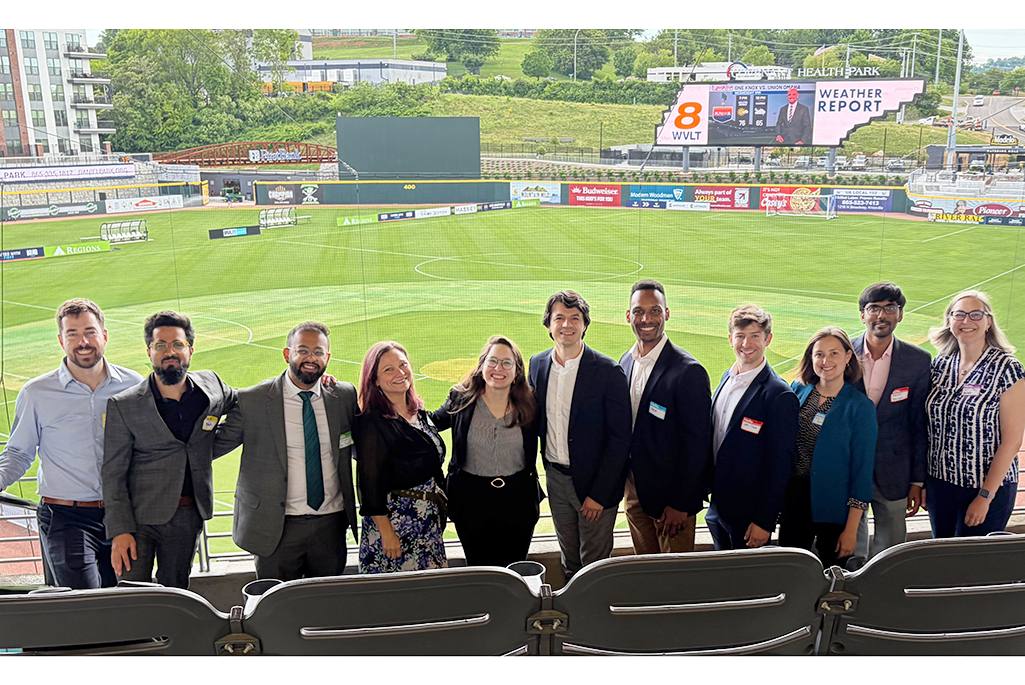
Cyclotron Road supports innovators as they take the leap from discovery to product development and build out their own companies. The graduating fellows have received two years of research funding, a living stipend, entrepreneurial training in collaboration with non-profit partner Activate, and access to the multidisciplinary researchers and resources of Berkeley Lab to refine their technology.
The businesses these fellows are developing are contributing to advancements across critical minerals and materials, semiconductors, biomanufacturing, and more.
- Pauliina Meskanen and Nate Weger, Calectra: is building a novel thermal battery technology to enable a new era of cheaper and cleaner industrial heating. Its thermal battery converts low-cost electricity into high-temperature (1,600°C) heat for industrial manufacturing. The company recently secured funding from a major building materials consumer and won a California Sustainable Energy Entrepreneur Development (CalSEED) Cohort 7 Prototype Award.
- Mert Akin, EELI Technology: develops advanced lithium recovery solutions, making domestic lithium production viable from extremely low-grade sources. Lithium is used in everything from batteries to vehicles and medical treatments. By transforming untapped brines into feasible lithium sources, EELI aims to unlock the full potential of American resources.
- Carla Pinzón, Expand Power: uses high-frequency power electronics to create PowerGuard, an ultra-compact, controllable, smart transformer that is highly flexible, manufacturable, and configurable for solar developers, data centers, and utilities. Expand recently signed a Letter of Intent for $13M from a customer.
- Gabriella Dweck and Kelly Redmond, Oleo: provides biomanufacturing platform that converts agricultural and forestry waste into next-generation oil feedstocks, advancing U.S. energy independence and agricultural resilience. Gabriella was recently recognized on the Forbes 30 Under 30 List in the Energy & Green Tech category.
- Advait Holkar, Praio: develops artificial protocells — cell-like structures from synthetic polymers that create tunable microenvironments around enzymes, improving their performance. Praio views these protocellular biocatalysis as the key to enabling next-generation biomanufacturing and advanced biorefineries.
- Nosa Edoimioya, Reforge Robotics: creates software that enables robots to be used for manufacturing tasks where they previously did not have the required precision. Its vibration and force control software allows robots to take on tedious and dangerous industrial tasks, allowing humans to focus on work that requires judgment and ingenuity.
- John Slack, Rhoic: is developing the Maxwell Reactor, an AC-driven field-enhanced catalytic reactor that enables direct nitrogen oxidation without combustion, high pressure, or fossil fuel feedstocks. Using proprietary nanofiber catalyst scaffolds to concentrate and direct electric fields at the active catalytic surface, the Maxwell Reactor enables a new class of efficient, tuneable chemical synthesis.
- Hitesh Manglani, Supercarb: transforms carbohydrate biomass into tunable, high-performance, biodegradable fibers. Its biomaterials fortify the U.S. textile industry and enhance human health by eliminating the need for toxic, bioaccumulating chemicals in textile processing. Supercarb recently won Best Pre-Commercialization Startup at the National Laboratory of the Rockies Industry Growth Forum 2026.
- Rushin Contractor, Topolight: enhances the power and efficiency of semiconductor lasers, enabling the creation of compact devices capable of emitting high-intensity light. Its next-generation lasers can improve the reliability and lower energy consumption in data centers while also being applicable to a wide range of applications, including quantum computing, satellite communications, and autonomous vehicles.
The fellowship program aims to support these entrepreneurs with the credibility and resources to make rapid progress in translating their ideas into viable products.
“Cyclotron Road has been instrumental in helping us accelerate our technology,” said Gabriella Dweck, co-founder of Oleo together with Kelly Redmond. “It’s provided us not only with vital lab space and scale-up tools, but connections with Berkeley Lab experts in biomanufacturing.”
The DOE’s Advanced Materials and Manufacturing Technologies Office (AMMTO) has been the founding and anchor sponsor of Cyclotron Road. Other partners who have supported the program include DOE’s Building Technologies Office (BTO), Office of Geothermal (OG), Bioenergy Technologies Office (BETO), Office of Electricity (OE), Federal Energy Management Program (FEMP), The Defense Advanced Research Projects Agency (DARPA), as well as the University of California Office of the President (UCOP) with the State of California, the California Energy Commission (CEC) and Activate.
###
Lawrence Berkeley National Laboratory (Berkeley Lab) is committed to groundbreaking research focused on discovery science and solutions for abundant and reliable energy supplies. The lab’s expertise spans materials, chemistry, physics, biology, earth and environmental science, mathematics, and computing. Researchers from around the world rely on the lab’s world-class scientific facilities for their own pioneering research. Founded in 1931 on the belief that the biggest problems are best addressed by teams, Berkeley Lab and its scientists have been recognized with 17 Nobel Prizes. Berkeley Lab is a multiprogram national laboratory managed by the University of California for the U.S. Department of Energy’s Office of Science.
DOE’s Office of Science is the single largest supporter of basic research in the physical sciences in the United States, and is working to address some of the most pressing challenges of our time. For more information, please visit energy.gov/science.
